Guides
How to build a corporate academy
A corporate academy is not a video site. Purpose, catalogue, assignment, exams and records. A step-by-step setup, and what not to do in the first 90 days.
Published 20 August 20263 min read
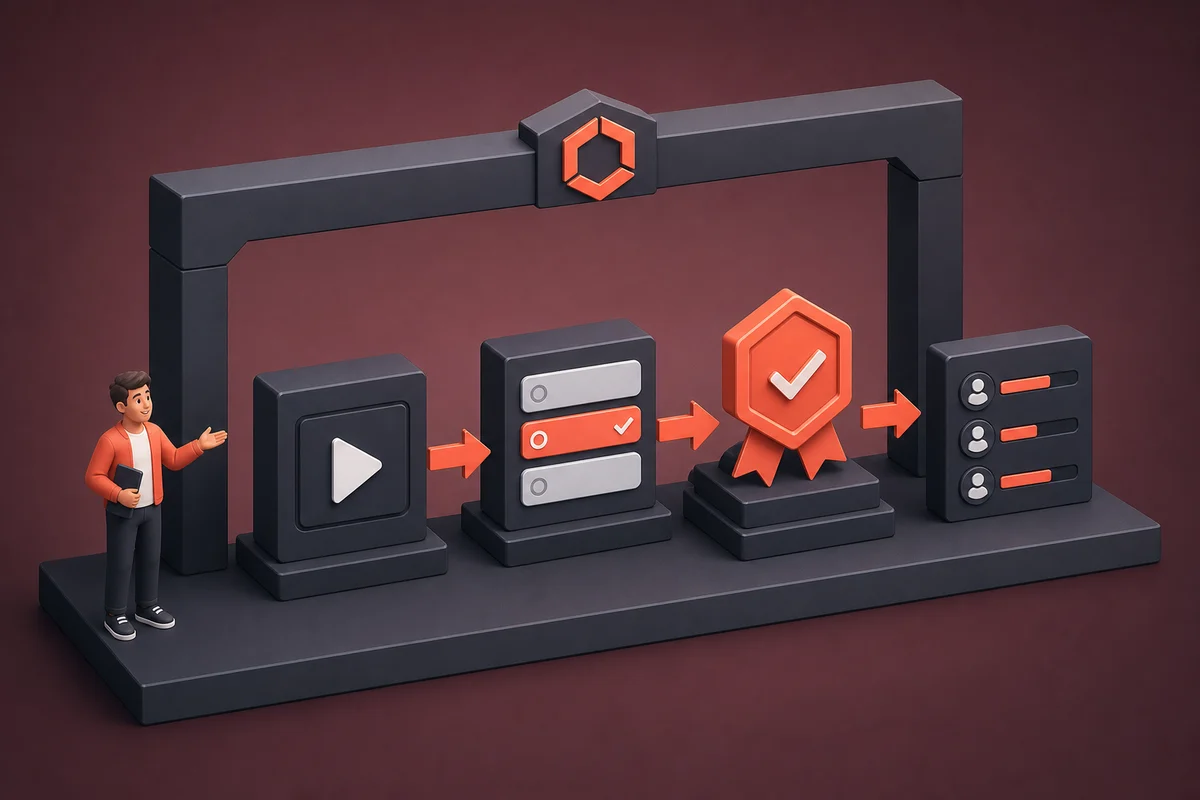
A corporate academy is the name a company gives its own training operation. Sometimes university, sometimes L&D portal, sometimes "learning space". The name changes. The work does not: employees, and sometimes customers or partners, come in through your brand's door, finish an assigned path, and a record of that finish remains.
Building an academy is not hiring a content studio. A studio produces video. An academy carries assignment, reminders, exams and reports. Without video the academy is weak. Without a process, a pile of videos is not an academy.
Pick the work that already exists. Do not pick everything
The first programme should be one. Onboarding, product training, mandatory renewal or partner certification. Promising all four "at launch" leaves all four half-done. Use cases exist for that reason: a list of jobs, not a list of features.
Split who comes in
If employees, customers and external trainers should not share a door, the spaces stay separate. One company, one academy is enough most of the time. Several brands or clients make learn space isolation the first job, not the theme colour.
Draw a path, not a catalogue
"12 videos" is a shelf. A path is: this role, this order, the next step stays closed until the required piece is done. In onboarding, week one is separate from the manager track. In a customer academy, product A is separate from product B.
Wire measurement in from the start
A quiz, an online exam, a practical task. Pass mark, number of attempts, whether a certificate exists. If those are bolted on after the videos, the academy becomes a watching site.
Write the owners down
Content owner, assignment owner, report owner. All three can be the same person. If they are not written, none of them exist. The title "head of academy" is decoration on anyone who does not open the weekly late list.
Open to a small group, then publish
One team, one role, two weeks. Accounts, mobile, reminders, exam, report. Mailing the whole company on day one is not a launch. It is a load test.
What not to do in the first 90 days
- Call every department for content and wait on an empty shelf
- Argue the brand guide for three months before the LMS
- Say "AI will write the courses, we'll look later" and never write a rule
- Upload old PDFs with no version note
- Measure success as "how many videos are there"
Success is the job you picked actually closing: onboarding done by day 30, exam results used, certificate dates not missed.
Where the content comes from
Most academies are already written: a handbook, a procedure, field notes, a sales deck. Turning those into lessons is a separate job; the course editor and ready-made programmes shorten it. Writing 200 lessons from scratch is not a launch requirement. The launch requirement is that the path for the work that already exists is visible in the system.
Where software sits
For a corporate academy, software must not lose three things: your domain, your assignment, your record. On learn.place that is a programme, an exam and automation on the same spine inside a learn space. The content is your policy. Software stops the policy from falling into an email attachment.
Open the academy in your own space
Go to Learn Spaces